 Prism and TMS both work on brain circuitry, but in opposite directions. A psychiatrist who offers both explains how they differ, what each treats, and how to think about choosing.
Key Takeaways
- TMS and Prism are both non-invasive, drug-free, brain-based treatments, but they work in opposite directions: TMS delivers magnetic stimulation into the brain, while Prism only reads brain activity and teaches you to change it yourself.
- They are cleared for different conditions. TMS is FDA-cleared for depression, OCD, and smoking cessation. Prism is FDA-cleared as an adjunctive treatment for symptoms associated with PTSD.
- TMS is a passive treatment — you sit still while the device works. Prism is an active one — you practice a skill and take it with you after treatment ends.
- For most patients the choice isn't really a contest between the two; it follows from the diagnosis. The more useful question is which treatment fits your condition, and whether more than one belongs in your plan.
- Diamond Edge TMS in Vancouver, Washington, offers both TMS and Prism for PTSD, along with psychotherapy and medication management — all directed by one physician. Schedule a consultation to talk through which approach fits your situation.
Request an Appointment
Two Brain-Based Treatments, Two Very Different Ideas
Patients who have started researching drug-free options for depression or PTSD often arrive with a reasonable question: transcranial magnetic stimulation and Prism both work on the brain, both avoid medication, both involve sitting in a chair with something on your head. So what actually separates them?
The short answer is direction. TMS sends energy into the brain. Prism takes information out of it.
That distinction shapes everything else — what each treats, what a session feels like, how long the effects last, and what you're left with when treatment ends. At this time, Diamond Edge TMS is the only practice in the Portland–Vancouver area to offer both, which means we can recommend the tool that fits your diagnosis rather than the one that happens to be in the building.
At a Glance
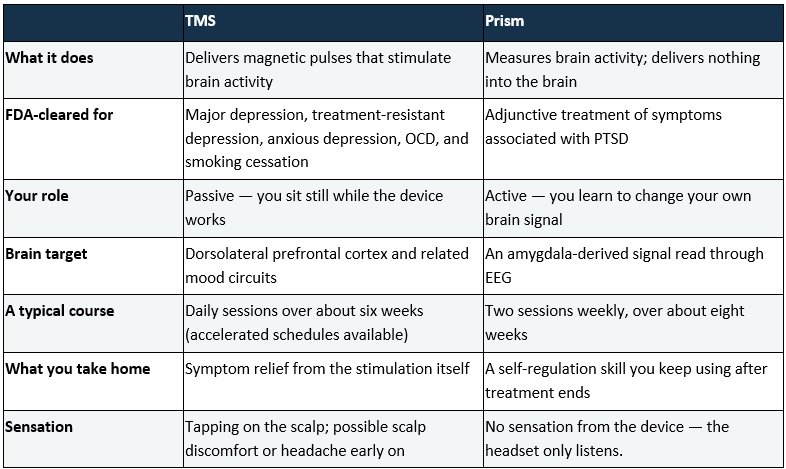
How TMS Works
Transcranial magnetic stimulation uses a magnetic coil placed against the scalp to generate focused magnetic pulses. Those pulses pass painlessly through the skull and induce small electrical currents in the brain tissue underneath, stimulating regions involved in mood regulation — most commonly the dorsolateral prefrontal cortex, which is typically underactive in depression.
Repeated daily over several weeks, that stimulation appears to strengthen activity in circuits that have grown sluggish. The treatment does something to the brain, and the brain responds.
A session is straightforward: you sit in a chair, awake and alert, while the coil is positioned and the device delivers pulses in cycles. Most people describe a tapping sensation on the scalp. There is no anesthesia and no recovery period — patients read, listen to music, or talk, and drive themselves home afterward.
TMS is FDA-cleared for major depressive disorder, treatment-resistant depression, depression with comorbid anxiety, obsessive-compulsive disorder, and smoking cessation. It has become a mainstay for patients whose depression has not responded adequately to medication.
How Prism Works
Prism does the opposite. Nothing is delivered into your brain at all.
You wear an EEG headset that reads your brain's electrical activity through the scalp. Using a biomarker developed by fusing EEG and functional MRI data, the system tracks a signal associated with activity in the amygdala — the brain's alarm center, which runs persistently overactive in PTSD.
That signal drives an interactive simulation on a screen. In one scenario you watch a restless, noisy waiting room; your task is to settle it. The only way to do that is to calm your own stress signal. As the biomarker quiets, the scene quiets with it. Over roughly eight weeks, you discover mental strategies that work for you and practice them until they become reliable.
Prism is FDA-cleared as an adjunctive treatment for symptoms associated with PTSD, meaning it is used under a physician's direction alongside your other care. For a fuller explanation of the science, see What Is Prism for PTSD and How Does It Work?.
The Difference That Matters Most: Passive vs. Active
If you take away one distinction, make it this one.
With TMS, the treatment happens to you. Your job is to show up and sit still; the device does the work. That is genuinely an advantage for many patients — particularly people so depressed that mustering effort is itself the problem. Severe depression saps concentration and motivation, and asking someone in that state to practice a skill can be asking too much. TMS meets them where they are.
With Prism, the treatment happens through you. The device provides feedback, but the change comes from your own effort. That demands more of you during treatment, and it gives more back afterward: the regulation skill you build doesn't stop working when the sessions end. In the clinical trial supporting FDA clearance, improvements were maintained at three-month follow-up — consistent with patients having learned something durable rather than simply having been treated.
Neither model is better in the abstract. They suit different conditions and different moments.
How to Think About Which One Fits
In practice, the choice usually follows from the diagnosis rather than from a head-to-head comparison:
- If depression is the primary problem — particularly depression that hasn't responded to medication — TMS is the treatment with FDA clearance for that indication.
- If PTSD is the primary problem, Prism is the treatment cleared for symptoms associated with PTSD. TMS is not FDA-cleared for PTSD; research in that area continues, but clearance is what distinguishes an established indication from an investigational one, and patients deserve that distinction stated plainly.
- If both are present — a common picture among veterans and first responders — the sequencing question becomes the interesting one, and it's worth a real conversation with your physician rather than a rule of thumb.
When Both Conditions Are in the Picture
Depression and PTSD travel together often enough that many patients ask whether they must choose. Usually they don't have to choose so much as decide what to address first.
Sometimes depression is severe enough that it should be treated first, simply because a patient with no energy and no concentration cannot do the active work Prism requires. Lifting the depression can make the PTSD work possible. In other cases, PTSD-driven hyperarousal is clearly the engine — the sleeplessness and constant vigilance are what's grinding the person down — and quieting that first changes the whole picture.
There is no formula. It depends on symptom severity, what you've already tried, what your life can accommodate, and what matters most to you right now. That is a clinical judgment made with you, not for you.
What They Have in Common
The contrasts are real, but so are the similarities, and for patients weighing drug-free options these matter:
- Both are non-invasive. No surgery, no anesthesia, no sedation.
- Both are drug-free. Neither introduces a medication or its side effects.
- Both are FDA-cleared, with clinical trial evidence behind their indications — not wellness services or unregulated devices.
- Both let you return to your day immediately. You stay awake and alert throughout and can drive yourself home.
- Both work best as part of a complete plan. Neither replaces good psychiatric care, and both pair well with psychotherapy and, when appropriate, medication.
Why One Clinic Offering Both Matters
A practice that offers only one technology has an unavoidable incentive to recommend it. Diamond Edge TMS offers TMS, Prism, psychotherapy, and medication management — which means the recommendation you get reflects your diagnosis rather than the inventory.
It also means your care stays coordinated. In a single-physician practice, one doctor knows your full history, watches how you respond, and adjusts the plan. Nothing gets lost in the handoff between offices, because there is no handoff.
Dr. Block is a combat veteran and board-certified psychiatrist with more than 25 years of experience and psychoanalytic training. He understands the culture and the confidentiality concerns that come with military and first-responder careers, and he will tell you candidly when he thinks a treatment is not the right fit.
Talk It Through With a Physician Who Offers Both
You don't need to arrive at your consultation having decided. Bringing the question is enough.
Diamond Edge TMS offers both TMS and Prism in Vancouver, WA, minutes from Portland. Call (360) 838-3654 or request an appointment to talk through which approach — or which combination — makes sense for you.
Frequently Asked Questions
Can I have TMS and Prism at the same time?
This depends on your specific situation and should be decided with your physician. Some patients complete one course of treatment before beginning the other; in other cases a different sequence makes sense. Because both treatments are available at Diamond Edge TMS under one physician, the timing can be planned deliberately rather than dictated by what a given clinic happens to offer.
Is TMS approved for PTSD?
No. TMS is FDA-cleared for major depressive disorder, treatment-resistant depression, anxious depression, OCD, and smoking cessation. Research into TMS for PTSD is ongoing and some clinicians use it off-label, but Prism is the device with FDA clearance specifically for symptoms associated with PTSD. Dr. Block will explain what is cleared, what is investigational, and what that distinction means for you.
Which one works faster?
They follow different timelines and aren't directly comparable. TMS patients often begin noticing changes partway through a course of daily sessions. Prism builds a skill, so progress tends to be more gradual and more dependent on practice — but improvements were maintained three months after treatment ended in the clinical trial supporting FDA clearance. Individual results vary with both treatments.
Are either of them covered by insurance?
TMS is widely covered for depression by most major insurers, including TRICARE, though prior authorization requirements vary. Coverage for Prism is newer and varies by plan. Call our office at (360) 838-3654 and we will review your specific benefits before you commit to anything.
Do I have to stop my medication for either treatment?
Generally, no. Both TMS and Prism are commonly used alongside medication, and Prism's FDA clearance specifically describes it as an adjunctive treatment used together with other care. Any change to your medication is a separate clinical decision made with your prescriber.
